Count It All Joy
Mama Scrap’s Inc.
I come from secrets kept in medicine bottles
From men who were broken before they broke others
From hands that held rage with no room for tenderness
From cancer that ate the women who carried too much distress
From nerves that misfired after decades of watching it fall apart
From fire that was buried deep beneath the heart
From grief that was inherited like these high cheekbones
And pain that was passed down like family recipes with no instructions.
But I came with saltwater and matches
With dirt under my nails and altar songs in my throat
I am the boundary and the break,
the breath they were never allowed to take.
I light candles where they shut doors
And scream where they were told to only pray
I rest where they were worked to death
And remember what they were forced to forget in every breath.
I do not come from shame
I come from the holy.
Before I was born into this body
I belonged to a people who remembered being whole
From a lineage stretching back to women who knew land by taste not by name
From women who prayed with their hands deep in the soil,
From mothers who gave birth with fire at their feet, primal and royal,
From fathers who danced their grief down into the floor,
Then lit joy in the bones of the children they bore.
They were not without suffering
but there was balance and rhythm
a sacred obligation to the earth
and to one another.
With my arrival
The memory of wholeness kept pulsing
Slow but steady
Beneath generations of rupture,
Worn down but not unready.
I was born into a family with deep roots and tired branches
But I came with a knowing...
About what was missing and
What was sacred.
I tried to fix it
First by being good
Then by being strong
Then by being everything no one asked me to be,
yet everyone depended on.
Until I began choosing.
First quietly.
Then boldly.
Then irreversibly.
I chose to be a woman who could hold both fire and water
Without burning out or drowning under
Through ritual, intention, and reclamation.
And now the ancestors watch with approval
Not because I avoided the wounds
But because I learned how to heal them.
I am not the broken branch...
I am the returning root.
— Ree Belle
Letter from
Brittíni “Ree Belle”
To our Kinfolk, Fam, Funders, and Supporters,
Four and a half years ago, in the middle of a pandemic, I incorporated this organization with more vision than capacity and a clarity I could not argue with: my ancestors had given me an assignment and expected me to honor it. I was single. Our family was the team. We had no funding. I had a great-great-grandmother named Eliza, Mama Scrap, who had inherited land from her father in Mississippi in 1919, a mandate I could not put down, and a certainty, bone-deep and spirit-confirmed, that what I was building was not mine to abandon. What we have built since then is something I could not have mapped from the beginning, and that is precisely the point.
I did not anticipate how much this work would ask of me personally. Not programmatically. Not strategically. Personally. I have watched my mother fight for her life and her dignity across four years of caregiving that reshaped everything I thought I knew about sustainability, pace, and what it means to practice what you preach. I have loved a man and built a marriage and a blended family inside the same season I was trying to build an organization. I have grieved land that felt close enough to touch. I have learned, in my own body, that the frameworks we teach are not theoretical. They are survival instructions, and some seasons the person who needed them most was me.
And we built inside all of it. Inside a pandemic that exposed every lie this country tells about who matters. Inside an ongoing genocide that we refused to look away from when our movement siblings needed us to say their names out loud. Inside a political climate that has made it dangerous to be Black, to be poor, to be immigrant, to be queer, to be anything this system was not built to hold. Inside ecological grief that is not metaphor, it is weather, it is water, it is the tornado that came through our neighborhoods in 2025 and asked us what we were made of. We answered. We have been answering for four and a half years.
Our family is still the team — not by default or accident, but by intention. This calling is not just mine. Each of us carries purpose and connection to the work of this organization that is part of our destiny. And as a family, through community and connections that extend far beyond our bloodline, we are cultivating the liberated futures we envision together.
What I know now that I did not know when I started is that building is itself a spiritual practice. Not building as productivity. Building as ceremony. Every retreat we held, every altar we erected, every circle we opened, every meal we cooked for someone who needed to be fed, it was all ritual. It was all prayer. My deepening relationship with Ogun, and my practice of the Lukúmí faith, alongside the full breadth of Black spirituality I draw from including Yoruba wisdom, hoodoo, and the Black church, has given me a language for what I have always known in my hands. You do not build liberation like you build a product. You build it like you build a fire. Slowly. With the right materials. With people who know how to tend it. And you never stop watching it.
For Jessie, for Vera, for Eliza,
I am here because you were,
whole because you willed it so,
with love too clear to ever blur.
I carry your names into rooms you couldn’t enter
Say them like a prayer that steadies my center
I bow to what you carried, and carry your courage through...
Every good thing in me is a love letter, back to you.
I have also experienced what it feels like when the work is true. When 500 people come to an altar you built for a boy who deserved to live and you feel the grief move through a crowd like weather. When a birthing family calls months later and tells you what being held meant. When someone sits inside a rest installation and cries because they forgot they had permission to stop. When ten people look at everything you have built, imperfect and alive and still standing, and say yes.
I waited to write this report until I knew who we were becoming. I did not want to document a vision. I wanted to document a reality. What follows is four years of real work, real grief, real joy, and a real community still choosing this every single day. We are clearer now than we have ever been. Not because everything went according to plan. Because almost none of it did, and we are still here.
If you have walked with us, you already know what this cost and what it made possible. If you are new to this work, welcome. There is room for you here.
Brittíni “Ree Belle” Gray-Chiquillo
Founder and Executive Director, Mama Scrap’s Inc.
Moved by what you’ve read?
You can support this work right now — every gift, at every size, goes directly toward healing, land, and liberation.
Give NowWho We Are
Mama Scrap’s Inc. is a cultural abolitionist organization centered in community healing, land stewardship, political education, and the living practice of Black culture and spirit. We exist because the systems that organize modern life — 250 years of this country’s particular violence; more than 500 years of colonial occupation; approximately 6,000 years of patriarchal structuring of human society; the industrial revolution’s reorganization of land, labor, and relationship; the agricultural systems that strip soil the same way capitalism strips people — have brought us to a place of utter depletion. Of the planet. Of people. Of the imagination required to envision something genuinely different. That depletion is not an accident, not an inevitability, but the predictable outcome of interlocking systems built to produce exactly this, and Mama Scrap’s exists because we believe another way of being is possible, necessary, and already being built.
Abolition, as this organization holds it, is not only the dismantling of what has caused the harm. It is the simultaneous construction of what comes after, a new culture, a new way of organizing community, family, land, governance, care, one that tends the people, the planet, the relationships between them, rather than extracting until nothing remains. We are not waiting for the current system to collapse before we begin. We are building now, in grief circles, rest installations, land ceremonies, community meals, organizing schools, seasonal gatherings, the daily practice of showing up for each other with the care the systems around us have consistently refused to offer.
Our work moves through four pillars — Community Healing, Land Sovereignty, Political Education, and Culture and Spirit — four dimensions of one integrated project, four ways of practicing the same vision of a world where Black, Brown, and Indigenous people live in right relationship with the earth, with each other, with their own grief, rest, rage, culture, and spirit. These pillars do not operate in sequence or in isolation. They breathe together, each one feeding the others, each one incomplete without the rest.
We were founded in lineage. Our name belongs to Eliza, Mama Scrap, a Black woman who held onto land in Forest, Mississippi across generations because she understood what this organization has spent four years learning to say in full: that land is not property, culture is not content, healing is not a service, liberation is not something you tend after everything else is handled. It is the everything else. It always has been.
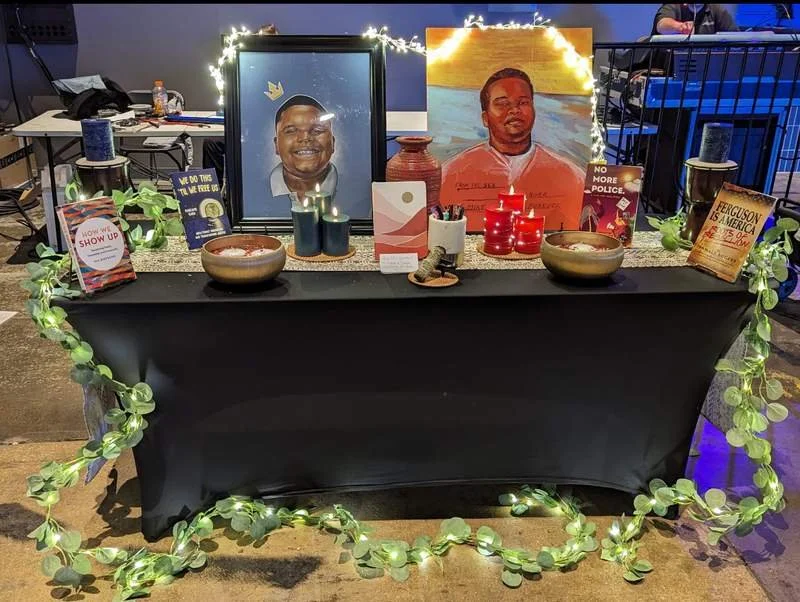
Mike Brown 10th Anniversary Memorial • August 2024
The Story
2021: Planting
Mama Scrap’s Inc. was incorporated in 2021 by three women, all family. Brittíni “Ree Belle” Gray-Chiquillo as Founder and Executive Director. Mama Rev. Regina Gray, her mother, as Board President and spiritual anchor. Aysha Lamara Gray, her younger sister, as Vice President and Agriculture and Sustainability Lead. The land they were committed to sat in Forest, Mississippi, 6.5 acres that had been in the family since Eliza, Mama Scrap, inherited them from her father who had accumulated more than forty acres. The organization was named after her not as tribute but as continuation.
Before incorporation was ever a consideration, The Breaking began. A seven-part virtual grief support series for BIPOC communities navigating loss in the middle of a pandemic that had made grief both unavoidable and unspeakable. The Breaking was not a program designed to make people feel better. It was a container for what was actually happening, an acknowledgment that unmourned loss does not disappear, it just changes shape. It became the first proof that Mama Scrap’s understood something most organizations avoid: that the work of liberation has to reckon with what the struggle costs the people doing it.
Also that summer, the capital campaign took shape. The organizational team was family. The campaign team was something different entirely, a circle of white, Jewish, and Asian women who understood the vision of Black land sovereignty and reparations clearly enough to put their hands to the actual work of running the campaign. That coalition, across difference and toward a shared commitment, was itself a demonstration of what Mama Scrap’s believed was possible.
That December, Mama Scrap’s launched publicly with the Weekend of Sacred Resistance, a series of virtual gatherings that brought 150 people together to honor Black women freedom fighters, sit inside reparations as ancestral healing, and reckon with what it means to become good ancestors. The weekend raised $55,000 and introduced the framing that still moves through everything this organization does: Return, Reclaim, Rematriate, Retreat.
That same year, full-spectrum doula support launched through Akōkō Nació Doula+ Care, and rest installations began finding their first communities. The organization was small, under-resourced, and unmistakably present.
2022: Holding Through Pressure
2022 is the year Mama Scrap’s Inc. formally incorporated as a 501(c)(3) nonprofit, a milestone that marked the legal and structural formalization of a vision that had already been moving for years. In the spring of the same year, Mama Rev. Regina suffered a severe MS exacerbation that required hospitalization and the kind of sustained family presence that reorganizes everything around it. What began as a crisis became a four-year caregiving arc that reshaped how the organization understood capacity, sustainability, and the difference between speed and depth.
Mama Scrap’s made decisions from care rather than urgency and in doing so, began practicing in real time what it had been teaching. Rest as resistance is easy to name in a workshop. It is a different thing entirely to choose it when the grants are watching and the timeline is slipping. Mama Scrap’s chose it anyway. Meanwhile, the capital campaign team continued to work behind the scenes, raising an additional $150,000 that year alone, a testament to the belief our community had in the vision even when the organizational pace had slowed.
The community healing work deepened across this year. Akōkō Nació Doula+ Care continued reaching Black birthing families across the St. Louis region. Rest installations moved through organizational retreats, wellness days, and movement gatherings. The Breaking continued holding grief in community. That spring, Brittíni addressed the Women Working for the Earth Summit, speaking to hundreds on land, ecology, and the knowledge Black and Indigenous women carry in their lineage and their hands.
2023: Roots Spreading
2023 was a year of quiet width. Through the Birth Justice Fund Rapid Response Grant, Akōkō Nació Doula+ Care deepened its recurring community programs that would come to define Mama Scrap’s relational model. Thursday Parent Circles held space weekly for grief processing, cultural practice, and shared meals. Monday Listening Circles offered virtual small group support rooted in presence rather than advice. A bilingual parenting group, held in both Spanish and English on Wednesdays, created space for collaborative problem-solving across language and culture. Monthly Lactation Circles, rooted in indigenous practice, brought breastfeeding families into community with each other. These were not one-time events. They were the sustained, recurring relational infrastructure that makes community healing something more than a workshop.
In November, when the world watched genocide unfold in Palestine in real time, Mama Scrap’s refused silence. Brittíni published a public letter grounding solidarity in the long memory of mutual witness between Black and Palestinian struggle, recalling how Palestinians had taught Ferguson protesters how to respond to tear gas, how these movements had recognized each other across decades and continents. The letter was not a risk calculation. It was the framework in practice: you cannot build a culture of healing while looking away from what is doing the wounding. That willingness to say what others would not became part of Mama Scrap’s public character, and it has not changed.
2024: A Year of Major Reach
2024 was the year Mama Scrap’s showed what it could do with very little and refused to make itself small about it.
In March, a sacred Land Blessing Ceremony on the Mississippi property gathered Choctaw tribal members, descendants of enslaved Africans, and white allies in ritual, mutual accountability, and visioning. It remains one of the most meaningful gatherings in the organization’s history. Later that year, a dispute with neighboring property owners over an easement forced a pivot. Rather than fight for a site that had become contested ground, Mama Scrap’s made the decision to purchase a new plot of land ten minutes away, a site with cleaner boundaries and clearer possibility. That new site became the home of the retreat vision, and it was that site the builders would later walk away from.
The organization held retreat space for nearly 50 people that year across three distinct offerings. The RestAway Retreat in January held 13 people in a three-day restorative container rooted in the conviction that rest should not require wealth or distance from community. When We Rest in March gathered 20 people through a full day of embodied rest, ritual, and communal release. A Women’s Retreat in Chicago in June held 15 women in womb healing and collective care.
For one week in August, Mama Scrap’s facilitated a community altar at the 10th Anniversary Memorial of Mike Brown Jr., holding grief and rage and remembrance across an entire week of witness. Over 500 people moved through that space.
In February 2024, Mama Scrap’s launched its first sound bath offerings, and later that year Mama Scrap’s Sound Collective took formal shape, organizing that work into a named offering rooted in the understanding that the body sometimes needs frequency when it cannot receive words.
Doula care reached 50 people across 28 families that year, closing the grant period with a Winter Ceremony that honored the families walked alongside, the thresholds crossed, and the lives now living that were only possible because someone showed up.
Behind the public-facing work, the intellectual labor that would define the organization’s next chapter was taking shape. The Politicized Healing framework came into full form. The Healing Under Capitalism curriculum was drafted in its entirety. And the Fallow Ground organizing framework was articulated with the precision that comes from fifteen years of frontline work finally finding its form.
2025: Arriving
2025 was the year Mama Scrap’s became fully itself.
Thikamor Nights launched in February, a monthly dinner held in the family home centering Afro-Colombian cuisine from Cartagena, music, storytelling, and the kind of connection that forms around a table where no one has to explain why they are tired. Named for the thick and multifaceted love at the center of Brittíni and Jorge Gray-Chiquillo’s marriage, where thick meets amor, the inaugural series ran through April and brought 35 people to the table. Culture, nourishment, and belonging practiced as political acts.
In May, a tornado moved through parts of St. Louis and asked the community what it was made of. Mama Scrap’s answered. Four Resting Ground pop-ups brought sanctuary directly into devastated neighborhoods, reaching 150 people with rest and presence when the world they had known had just been rearranged. Two weeks after the tornado, in partnership with InPower Institute, Mama Scrap’s co-led a prayer walk through Forest Park where Brittíni “Ree Belle” led a libations ceremony, calling the community back into spiritual grounding in the middle of collective shock. In November, Joyfest brought hundreds of community members together six months after the tornado to heal, reclaim joy, and reassert community power.
Position papers were written that year, living documents naming what Mama Scrap’s believes, what it refuses, and what it is committed to building. They are the orientation material for every kinfolx who joins and the clearest public articulation of who this organization is in its own voice.
In August, Brittíni delivered the closing address at the St. Louis Racial Equity Summit, speaking to 250 people at the region’s premier racial equity convening. In October, Mama Scrap’s became fiscal sponsor for Some Things Must Be Heard: Spitting and Politicking, a project led by Tracy Stanton building a base of embodied artists and cultural organizers in St. Louis. The organization’s first fiscal sponsorship relationship.
In November, Rooted Communion gathered 40 people for shared food, storytelling, and the formal welcome of the First Fire kinfolx. Ten people joined Mama Scrap’s as inaugural members. Ten people who looked at four years of imperfect, grief-held, visionary work and said yes.
At the end of the year, the builders contracted for the new Mississippi site walked away from the agreement, leaving the project incomplete and the community’s investment undelivered. Mama Scrap’s engaged legal counsel, maintained full transparency, and made the decision that protects both the trust placed in the organization and the long-term vision: the funds are being stewarded faithfully until the right land and the right partners arrive. What was lost was a timeline. The vision did not move.
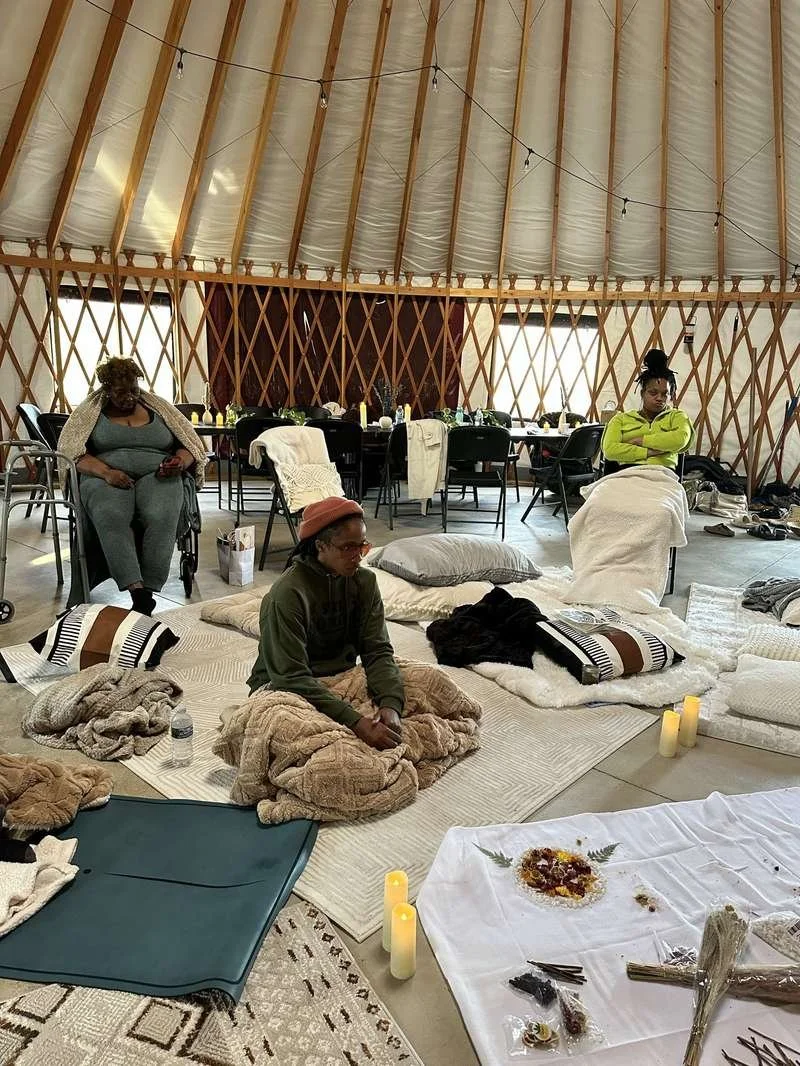
When We Rest • 2024
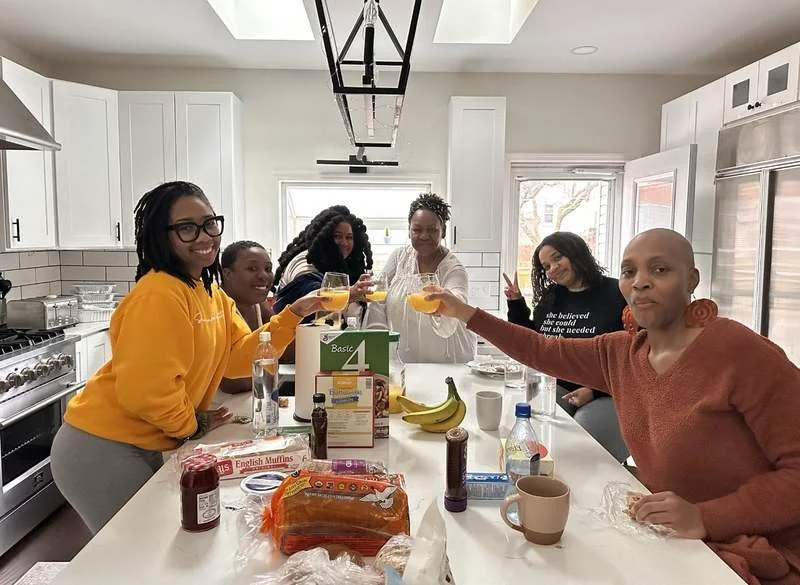
RestAway Retreat • January 2024
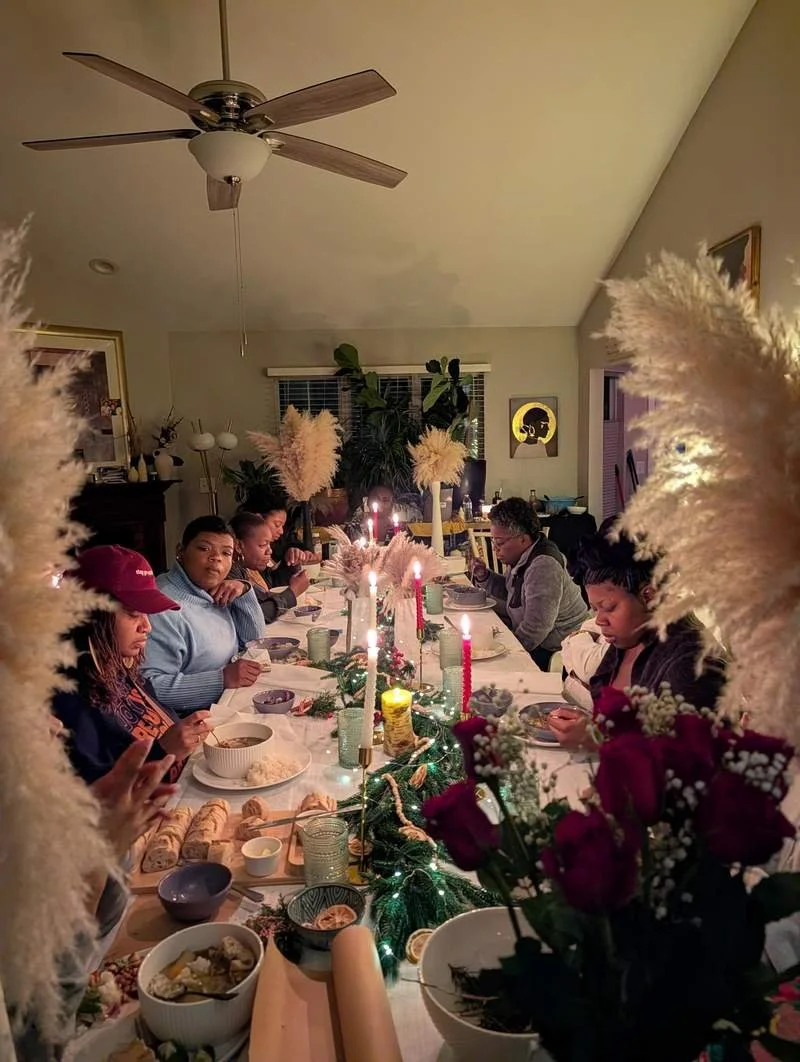
Winter Solstice Dinner & Ceremony • 2025
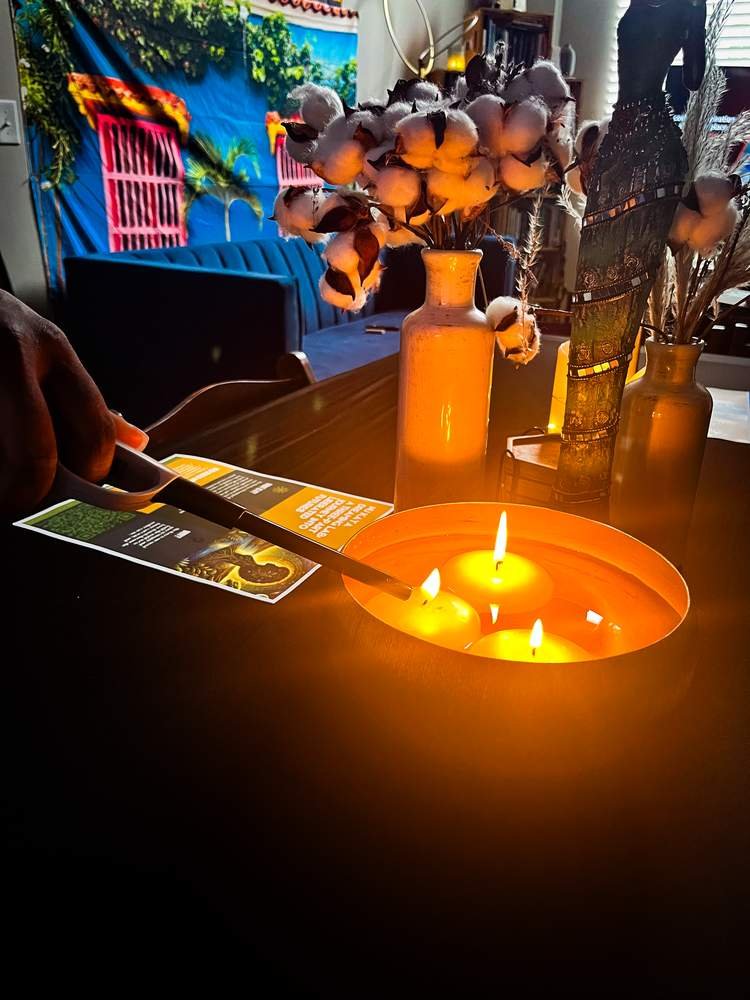
Winter Solstice • 2025
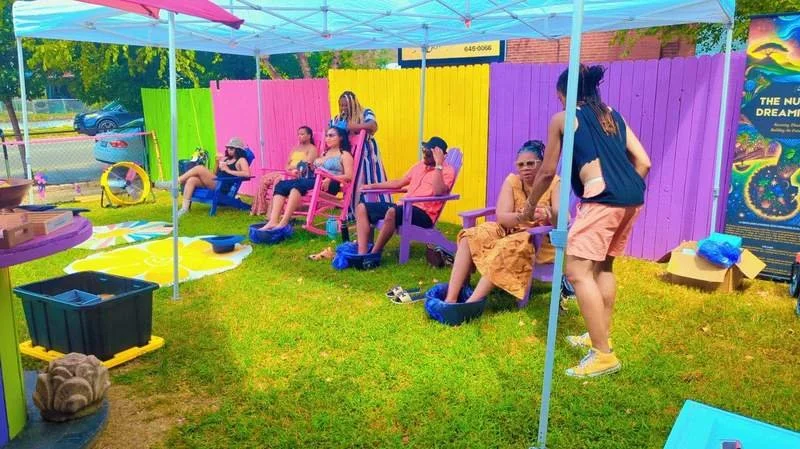
Resting Ground Pop-up • 2025
The Philosophy of the Work
The four pillars of Mama Scrap’s are not a program menu or a strategic framework developed in a planning retreat. They are the living architecture of a single, integrated vision, and understanding them requires understanding that they were not designed to operate independently. Each pillar is a full dimension of what it means to build an abolitionist alternative to the world we are currently inhabiting, and each one requires the others to be fully itself.
Land Sovereignty
The relationship between Black people, Indigenous peoples, and this land is among the most layered, most deliberately severed, most spiritually significant, most persistently maintained relationships in the history and prehistory of this country, and Mama Scrap’s does not approach land as a program area or a strategic priority so much as an inheritance, a responsibility, and a spiritual orientation that precedes the organization’s founding and will outlast any particular piece of property it holds, loses, or searches for in any given season.
The organization’s relationship to land begins with Eliza. Her father accumulated more than forty acres in Forest, Mississippi, and in keeping with the patriarchal customs of his era, chose to allocate land only to the men in his family. Eliza received her portion after she married, which means she moved within the constraints of a system that was not built to honor her claim, subversively, radically, with full knowledge of what was being withheld, taking hold of what was hers anyway. What she held onto was not simply acreage. It was the understanding, bone deep and spirit confirmed, that land is not property. It is the condition of dignity, the ground of memory, the place where food, ceremony, and generational continuity become possible. This organization carries her name forward not as tribute but as continuation, as the living expression of the mandate she left in that soil.
Land Sovereignty, as this organization practices it, is rooted in ecowomanism, the framework that names and honors the particular relationship Black and Indigenous women have always maintained with the earth, across Middle Passage, the Great Migration, and every engineered form of dispossession this country has visited upon people whose connection to land it needed to sever in order to justify taking it. That connection did not break. It traveled, adapted, persisted in the gardens behind shotgun houses, in seeds carried across water, in the rootwork, plant medicine, and conjure that Black women kept alive because they understood, in a way the dominant culture has never fully reckoned with, that the earth is not a resource to be managed but a relative to be tended.
Our future ecovillage is the vision Mama Scrap’s is building toward: a self-sustaining home for Black, Brown, and Indigenous communities, designed not as a retreat center or a wellness campus but as a living alternative infrastructure, a place where communal life, ceremony, food sovereignty, political education, grief, governance, rest, the raising of children, and the honoring of elders all happen in one container, held by land that belongs to the community. The path toward that vision has been longer and more difficult than the original timeline imagined, shaped by an easement dispute that forced a pivot to a new site, then by builders who did not honor the agreement they made. The funds raised for this land are being held with the same intention they were given. The search continues with the same conviction that has carried this work since Eliza put her hands in Mississippi soil.
In the meantime, a partnership with InPower Institute at God’s Acres in O’Fallon, Missouri is currently being negotiated, with plans to develop an orchard and a ritual gathering space for ceremony, seasonal practice, and land-based healing. The vision for what that site will hold is already alive, even as the formal agreement takes shape.
Healing as Praxis
There is a particular kind of exhaustion that does not show up in any diagnostic category, that does not have a name in the wellness industry’s glossary, that cannot be addressed by a breathing exercise, a sabbatical, or a therapy copay, and it is the exhaustion of people who have been surviving systems that were never designed with their survival in mind, carrying grief that was never given a container, moving through daily life in bodies that have absorbed generations of collective trauma without ever being offered a collective space to set it down. This is the exhaustion Mama Scrap’s was built to address, not as a service, not as a program offering with outcomes and deliverables, but as an organizational commitment to the proposition that healing, when it is real, is communal, political, spiritually rooted, and inseparable from the work of building a world where the conditions that created the wound no longer exist.
Community Healing is the understanding that no one heals alone, that the conditions which wound us are collective, the traditions that restore us are communal, and the future we are building requires that we tend each other with the same rigor and intention we bring to any other form of organizing. It is a practice that holds the whole person, mind, body, spirit, emotion, culture, and ecological relationship, within the whole community, refusing the fragmentation that treats mental health as separate from physical health, physical health as separate from spiritual care, spiritual care as separate from cultural continuity, cultural continuity as separate from land relationship, and all of it as separate from the political conditions actively working against our wholeness. At Mama Scrap’s, Community Healing is not a program or a service category. It is the orientation from which everything else moves.
This field is being actively developed in partnership with InPower Institute and the Black Healers Collective, and it is distinct from healing justice, though it learns from that lineage. Healing justice centers the sustainability of healers and movement workers. Community Healing extends that question outward, to the whole community as the unit of care, across generations, modalities, and the full spectrum of what human beings need to be not just functional but whole.
Politicized Healing is the framework we use within this broader field, the lens that names why harm is systemic, organized, and targeted, and why healing must therefore also be systemic, organized, and political. It understands the chronic exhaustion, fractured nervous systems, privatized grief, severed land relationships, and cultural erasure our communities carry not as individual misfortunes but as the predictable, measurable outcomes of systems designed to produce exactly those conditions. What distinguishes our practice is that it does not locate the work primarily in clinical or methodological frameworks, but in Black cultural traditions, spiritual technologies, and the embodied knowledge communities have always carried about how to tend each other, how to move grief, and how to work with rage as information rather than liability. The somatic dimension of this work is cultural rather than prescriptive, built to meet people exactly where they are, accessible to someone who has never been in a healing space before, who walks in carrying fury with nowhere to go, and who leaves having felt something shift without needing a vocabulary for what happened.
Community Healing, finally, is not the support structure for the other pillars. It is the ground they all grow in, the practice that makes the land work spiritually coherent, the political education embodied rather than merely intellectual, and the culture and spirit not just preserved but lived in the body of a community that has been tended well enough to dream again.
Political Education
Political education, at Mama Scrap’s, is the dimension of the work that names what made the healing necessary, that gives language to the systems, ideologies, and structures responsible for the depletion we are tending, that builds the analytical capacity to understand what we are up against clearly enough to construct something genuinely different. Where healing restores the conditions under which people can think, dream, feel, and relate with their full capacities available to them, political education sharpens what people do with those capacities. These are not sequential. They are simultaneous, each one deepening the other, the analysis making the healing more precise, and the healing making the analysis more honest.
Mama Scrap’s is building a school, still taking shape and still becoming, that will be an alternative formation ground for organizers, healers, cultural workers, and anyone seeking to build and inhabit a genuinely different way of life than the one this system offers. It grows from the same soil as The Breaking, the grief series that launched in June 2021, grounded in the understanding that what breaks open must be allowed to become something, and that formation is the container for that becoming. The school is not yet launched but the frameworks that will anchor it are alive and in use.
Those frameworks include the Fallow Ground organizing philosophy, named for the agricultural practice of leaving land intentionally unplanted so that its fertility can be restored, and the curricula being developed within it: Healing Under Capitalism, which examines chronic illness, isolation, scarcity, and generational trauma as predictable outcomes of a system built on extraction; the Nu Kaya Dreaming Lab, which reclaims imagination as a liberation tool and moves participants from vision into the design of parallel systems; and the Rooted Rebellion curriculum, a living framework for healing-centered world-building organizing still being developed in relationship with the communities it will serve.
Political education also happens outside any formal curriculum, in the public witness this organization has consistently offered when clarity was more costly than silence. The November 2023 letter For Palestine named what was happening in Gaza with the specificity and solidarity of an organization that understands its own liberation as inseparable from the liberation of all people living under occupation and siege. The position papers written in 2025 are political education in document form, living texts that name what Mama Scrap’s believes, what it refuses, and what it is committed to building.
Culture and Spirit
Culture and Spirit is the soul of the entire project, the dimension of the work that holds ancestral memory, ritual, beauty, food, music, storytelling, seasonal rhythm, and spiritual practice, the things that make a people not just organized but alive, not just resistant but generative, not just surviving the present moment but connected to something that stretches in both directions across time.
Brittíni “Ree Belle” Gray-Chiquillo is a practitioner of the Lukúmí faith, one lineage within the broader practice of Black spirituality that grounds this organization, a spirituality that draws from Yoruba wisdom, hoodoo, the Black church, and the full breadth of what Black people have carried spiritually across the diaspora through centuries of forced migration and deliberate preservation. The relationship with Ogun, the orisha of iron, labor, the clearing of paths, and the warrior’s protection, shapes the discipline this organization practices around rest and rage, the way it understands grief and ceremony and land, and the insistence that spirit is not separate from strategy. When this organization holds a ceremony, builds an altar, or marks a seasonal threshold, it is doing so from inside a tradition of practice rather than borrowing the language of the sacred for effect.
Black culture, as Mama Scrap’s holds it, is not content, not heritage month programming, not a mood board curated for atmosphere. It is a living system of knowledge, practice, memory, and meaning that has survived every attempt to destroy it precisely because communities understood its stakes and protected it accordingly. Afro-Colombian foodways, Yoruba spiritual technology, the particular genius of Black American vernacular and storytelling, the memory of conjure women, midwives, and freedom dreamers, these are the curriculum. They are the practice. They are what this organization is accountable to and what it is working to extend into the next generation.
Thikamor Nights, seasonal ceremonies, Rooted Communion, and libations and altar work in public spaces are all expressions of this pillar in practice. When Mama Scrap’s shows up in public, it arrives with ceremony that creates sacred space inside secular settings and reminds everyone present that the work of liberation has always had a spiritual dimension that cannot be outsourced or abbreviated. The prayer walk through Forest Park two weeks after the St. Louis tornado, where Brittíni “Ree Belle” led libations in the middle of collective shock, was not a program response. It was the tradition doing what traditions are built to do, holding community in the places where ordinary language runs out.
When the grief has been witnessed, when the land has been blessed, when the food has been shared and the libations poured and the song has gone where words could not, what remains is the truth that our people have always known: that a life lived in full relationship with spirit, culture, and each other is not the reward at the end of the struggle. It is the struggle’s most radical proposition. Mama Scrap’s tends this dimension of the work because beauty is not incidental to liberation. It is evidence of it.
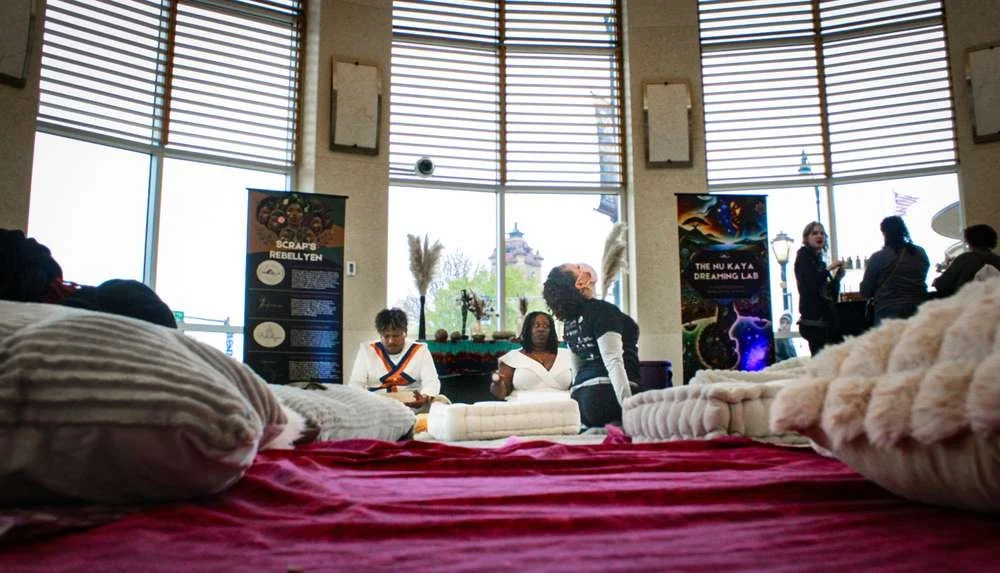
Rest Is Resistance Installation • 2025
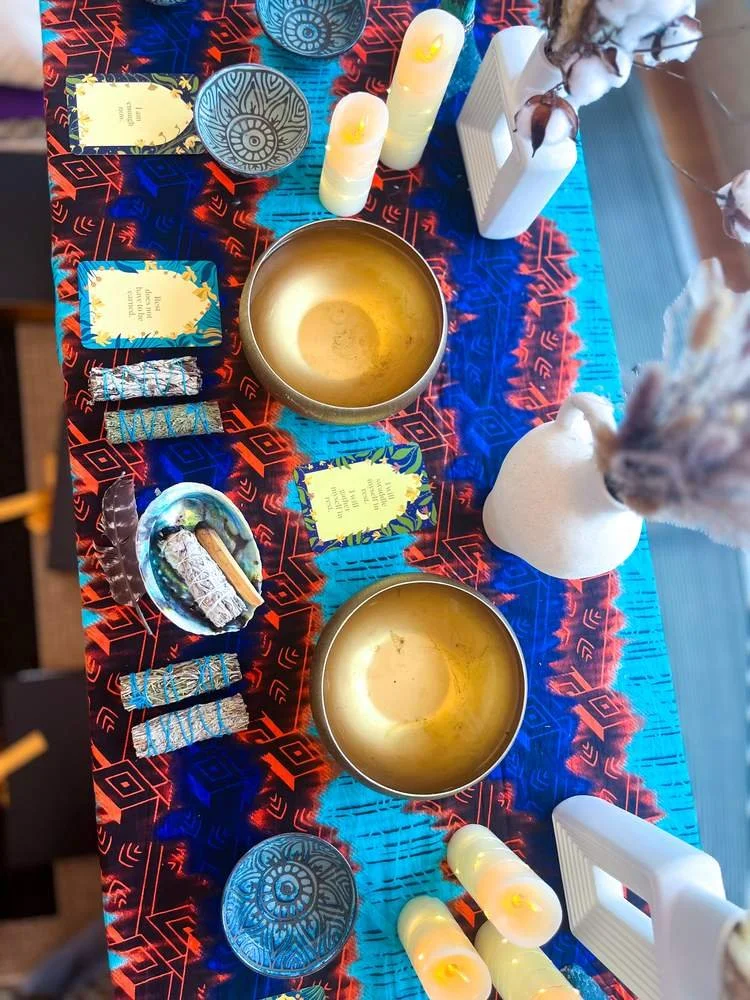
Altar & sacred tools • 2025
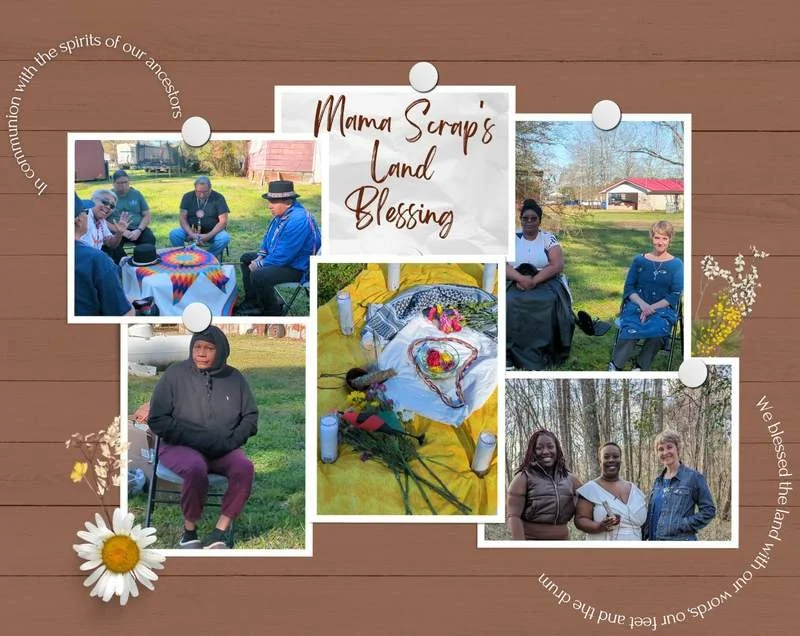
Land Blessing Ceremony • Mississippi • March 2024
Lessons and Losses
Four years of building Mama Scrap’s has taught me things I could not have learned any other way, and I am naming them here with the same honesty that has shaped everything else in this report, because I think the sector needs more organizations willing to say what they actually learned rather than what looks good in a lessons learned section.
On practicing what you preach
When Mama Rev. Regina’s health crisis began in 2022 and unfolded into a four-year caregiving arc, I faced a decision that most organizations in my position would not name publicly. I could push through, or I could slow down, make decisions from care rather than urgency, and trust that an organization built on the proposition that rest is resistance could actually practice it when practice was inconvenient. I chose the second path. It cost us momentum in the conventional sense. It gave us something no strategic plan could have purchased: the lived knowledge that the frameworks we teach are not theoretical. They are survival instructions, and some seasons the person who needed them most was me. That is not a weakness I am confessing. It is a credential I am claiming.
On the particular tax of visionary leadership
I have spent years softening the radical nature of what I am building so that it could be understood, funded, and received without triggering the particular anxiety that Black women with large visions tend to produce in rooms not built to hold them. This report is the place I stop doing that. The negotiation required to make visionary work palatable to conventional funders does not just cost you resources and time. It costs you clarity. The lesson is not that you should never translate your vision for different audiences. The lesson is that you must never lose the untranslated version, the one that does not need anyone’s permission to be exactly what it is.
On building in public while still becoming
Mama Scrap’s today is not the organization that incorporated in 2021, and it is not the organization it will be in 2029. The land question has moved. The programs have changed shape. Colleagues have come to the table and drifted away. What I have learned is that documenting work that is still taking form requires a particular kind of courage, the willingness to be accountable to a community while also being honest that you are still figuring things out. What has stayed constant across every shift is the mandate. Everything else has been, and will continue to be, in motion, and I have learned to trust that motion as evidence of life rather than instability.
On grief as organizational intelligence
Organizations grieve too, and the grief of lost land, broken agreements, departed colleagues, and deferred vision is real information. It tells you what mattered. It tells you what needs to be tended. Mama Scrap’s has metabolized a lot of grief across these four years, and I have learned that the organizations willing to do that metabolizing rather than pushing past it are the ones that build something durable rather than something merely impressive. Grief is not the opposite of growth. It is often its precondition.
On funding and what the sector will not say out loud
Program grants are time-limited by design, and the programs they fund sunset when the funding does, regardless of whether the community still needs them. What this organization needs, what most Black-led, community-rooted, visionary organizations need, is not more programs to run but sustained, unrestricted, multi-year operational support that allows the vision to mature at the pace it actually requires. I am naming that plainly here because the organizations that need to hear it are the ones reading annual reports.
On what the builders taught us
When the builders we contracted with in Mississippi walked away from the agreement, the first thing I felt was not rage, though rage came. It was grief, for the vision, for the families who had given to that campaign in faith, for the land we had blessed and planned and prayed over. What the builders also taught me is something I already knew but needed to know again in my body: that Black organizations seeking to own land and build permanent infrastructure are particularly vulnerable to the people who recognize that vulnerability and exploit it. The protection is not cynicism but discernment, the slow, deliberate, spiritually grounded practice of knowing who deserves to be trusted with what is sacred.
On community taking the time it deserves
We ended year four with ten inaugural First Fire kinfolx, and I know that number looks small by conventional metrics. By my own it is exactly right. I am not interested in a wide base of passive supporters. I am building a rooted community of people who understand what they are joining and choose it with their eyes open and their commitments named. That yes is worth more than any metric I could have optimized for.
On the confirmation that the work works
Across every offering, every retreat, every circle, every meal, every ceremony, every libation poured in public and in private, something has shifted in the people who showed up. I take that as confirmation not just that the work is worth the cost of building it, but that the tradition it comes from is intact, that Black spirituality, ecowomanism, abolition, community healing, and the daily practice of showing up for each other are not frameworks we borrowed for effect. They are the actual medicine. And the medicine works.
Where We’re Going
The next chapter of Mama Scrap’s is not a departure from what has been built. It is the full arrival of it, the season where the frameworks meet the formation ground, where the community meets the land, where the vision that has been practiced in rented rooms and borrowed spaces and family homes begins to find its permanent home in the world.
The organizing school we have been building toward is preparing for its internal launch with the First Fire kinfolx in 2027, an alternative formation ground for organizers, healers, and cultural workers anchored by the Fallow Ground framework and the curricula developed within it. The years between now and that launch are not waiting time. They are formation time, the building of the community, the deepening of the frameworks, and the cultivation of the relationships that will make the school what it needs to be.
New programming partnerships are being developed and deepened in 2026, along with an expanded commitment to retreat and spiritual offerings that meet people where the work of liberation actually lives: in the body. This includes a survival and preparedness workshop series equipping our community with practical knowledge for navigating hard times collectively, somatic workshops centering the release of rage and grief and somatic embodiment practices, and rest spaces held with live sound baths. These are not supplemental offerings. They are the work, practiced in the body, with the community, in the tradition this organization has always moved from.
The land search continues with intention and without urgency. The vision for our future ecovillage, a home where the daily life of liberation can be held together rather than fragmented across geographies, remains intact and active. The partnership with InPower Institute at God’s Acres in O’Fallon, Missouri continues to take shape, with the vision for an orchard and ritual gathering space alive and in development as the formal agreement is finalized.
What this next season asks for is not more visioning. The vision is clear. What it asks for is sustained, committed, unrestricted partnership from the people and institutions who have been reading this report and feeling something move in them.
By the Numbers
A Snapshot of Four Years of Healing, Land, Rest & Liberation — 2021–2025
Rest, Healing & Retreat Programs
Birthwork & Family Care
Healing & Grief Circles
Public Altar, Cultural Work & Keynotes
Community & Culture
Resources & Community Power
Numbers tell part of the truth.
The rest lives in every body that finally rested, every family held through birth, every altar that gave a grieving community somewhere to put it.
Mama Scrap’s has always known that impact is not a metric. It is a relationship.
From the Ground Up
Organizational Formation, Technical Assistance & Financial History
Becoming: Incorporation & Early Infrastructure
Mama Scrap’s Inc. was founded in 2017 as an initiative within InPower Institute. In 2022, that calling was formalized when the organization formally incorporated as a 501(c)(3) nonprofit. With the guidance of Innovative Change Consulting Group, LLC, Mama Scrap’s filed its incorporation documents, established its bylaws, built its logic models, and trained its inaugural Board of Directors.
Technical Assistance: The Builders Behind the Work
Innovative Change Consulting Group, LLC (2021–2022) — Legal and structural foundation: incorporation filings, bylaws, logic models, and inaugural board training.
Emergence LLC (2022–2023) — Contracted through Kalliopeia Foundation’s organizational capacity program. Grant-seeking posture, communications and fundraising infrastructure, growth plans.
Sacred Legal Circles (2024–Present) — Builder rupture guidance, local legal counsel, ecovillage plan revision, orchard lease integrity.
Grant Funding History (2022–2025)
2022 — Year of Foundation| Funder & Purpose | Amount |
|---|---|
| Kalliopeia Foundation (via Solidarity STL, fiscal sponsor) • General operating | $50,000 |
| Hilary & Pete Giovale (via RSF | Regenerative Social Finance DAF) • General operating | $50,000 |
| Common Counsel Foundation • Capital campaign / land project support | $80,000 |
| Tides Foundation • Capital campaign / land project support | $25,000 |
| 2022 Total | $205,000 |
| Funder & Purpose | Amount |
|---|---|
| Hilary & Pete Giovale (via RSF | Regenerative Social Finance DAF) • General operating | $50,000 |
| ioby (In Our Backyards, Inc.) • Sacred Resistance: Return — individual donor campaign | $57,432 |
| The Praxis Project • Birth Justice Fund Rapid Response Grant (first payment) | $15,714 |
| St. Louis Racial Healing + Justice Fund (FTF / Deaconess) • Unrestricted general operating | $22,583 |
| 2023 Total | $145,729 |
| Funder & Purpose | Amount |
|---|---|
| Hilary & Pete Giovale (via RSF | Regenerative Social Finance DAF) • General operating | $50,000 |
| The Praxis Project • Birth Justice Fund Rapid Response Grant (final payment) | $20,000 |
| 2024 Total | $70,000 |
| Funder & Purpose | Amount |
|---|---|
| Sow Joy Peoples Fund • 2-year general operating award | $125,000 |
| Hilary & Pete Giovale (via RSF | Regenerative Social Finance DAF) • General operating | $50,000 |
| 2025 Total | $175,000 |
Five-Year Documented Grant Total: $595,729
Additional funding received at the request of those funders is not reflected here.
The Reparations Campaign
Our Reparations Campaign generated $262,432 toward our ecovillage vision through three interconnected streams: the faithful multi-year giving of Hilary and Pete Giovale through their Donor Advised Fund at RSF Social Finance, our ioby crowdfunding campaign, Sacred Resistance: Return, and the more than $55,000 raised at our 2021 Weekend of Sacred Resistance summit. These are not grants. This is relationship. This is reparations as ritual made material.
Leadership Compensation
Beginning in 2023, Mama Scrap’s made a formal commitment to compensating its leadership, a radical act in a sector that routinely extracts labor from Black women founders and calls it passion.
| Year | Role | Stipend |
|---|---|---|
| 2023 | Brittíni “Ree Belle” Gray-Chiquillo, Founder & Executive Director | $35,000 |
| 2024 | Brittíni “Ree Belle” Gray-Chiquillo, Founder & Executive Director | $45,000 |
| 2025 | Brittíni “Ree Belle” Gray-Chiquillo, Founder & Executive Director | $50,000 |
| 2025 | Director of Land & Infrastructure | $20,000 |
| Total Leadership Compensation | $150,000 | |
Full Resource Allocation Summary
| Category | Amount |
|---|---|
| Land Reserves (through 2025) | $280,000 |
| Leadership Compensation (2023–2025) | $150,000 |
| Mississippi Land Project (preliminary land purchase, surveys, soil testing, site clearing, and builder loss) | $97,000 |
| Operations, Overhead, Accounting, Travel, Conferences & Program Delivery | ~$68,000 |
| Total Accounted | ~$595,000 |
Additional funding from confidential funders is reflected in total resources but not itemized above.
Board of Directors
| Rev. Regina Gray | President |
| Amanda Tello | Secretary & Treasurer |
| eNiKoL Wolf | Board Member |
EIN
87-2957253
Tax Status
501(c)(3) Public Charity
Financial Statements & Form 990: Mama Scrap’s Inc. financial statements and IRS Form 990 are available upon request. Please contact srmamascraps@gmail.com for copies.
Non-Discrimination Statement: Mama Scrap’s Inc. does not discriminate on the basis of race, ethnicity, color, national origin, religion, gender, gender identity, sexual orientation, disability, age, or marital status in the administration of its programs, services, or employment practices.
A Call to Build With Us
The ancestors did not build for audiences. They built for community, for the ones who would come after, for the world they could feel in their bones even when they could not see it with their eyes. Eliza did not hold that Mississippi land for recognition. She held it because something in her knew it mattered, that the ground beneath a people’s feet is never just ground, that what you protect now becomes what someone else gets to dream from later.
We are building in that same spirit. Not for applause, not for optics, not for a seat at a table that was never set with us in mind. We are building because the moment requires it, because our people deserve it, because the grief and the rage and the rest and the ceremony and the land and the school and the meals and the libations and the kinship and the vision have all been pointing somewhere real, and that somewhere is close enough now to feel.
If you have read this far, you already know whether this work is yours to be part of. You felt it somewhere in these pages. We are not asking you to believe in a pitch. We are asking you to trust what you felt.
Sustained, Unrestricted Operational Support
If you believe in this work, the most transformative thing you can do is fund it without conditions attached, multi-year, unrestricted, given in the spirit of partnership rather than oversight.
Our Future Ecovillage
The land is still coming. The funds are held, the vision is intact, the search is active. If you have land, know of land, or have resources to contribute to the capital campaign, bring that forward.
Programming & Cultural Work
The grief circles, rest installations, altar work, libations, community meals, and seasonal ceremonies all continue because our community needs them to continue.
Fiscal Sponsorship & Ecosystem Building
If you are building something aligned and need a home for it, or if you are a funder seeking to support the broader ecosystem this organization is part of, we want to hear from you.
Whatever you have to give, we are asking you to give it toward something that is reaching, with everything it has, toward a world where our people live in full dignity, on land that is theirs, in community that holds them, doing the work of liberation without being destroyed by it.
That world is not a metaphor. It is what we are building. And we are inviting you to build it with us.
Give online at givebutter.com/MamaScraps • Checks payable to Mama Scrap’s Inc. • 857 Harbor Woods Drive, Fairview Heights, IL 62208
General inquiries: info@mamascraps.org • Major gifts, partnerships & land: srmamascraps@gmail.com